
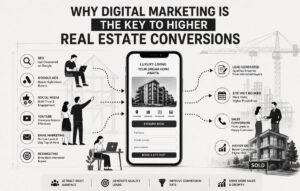
Why Digital Marketing Is the Key to Higher Real Estate Conversions
Real estate builders across India are navigating a market that has fundamentally changed. Buyers no longer walk into site offices first — they research on Google, scroll through Instagram Reels, watch virtual walkthroughs, and compare three projects before making a single call. Yet many builders still rely on hoardings, print ads, and channel partner networks as their primary marketing strategy.
The result? Low-quality leads flooding CRMs. Unsold inventory piling up. Ad budgets burning without ROI. And competitors with stronger digital presence taking market share.
The shift is clear: digital marketing for real estate builders is no longer an add-on. It is the system that drives site visits, generates qualified leads, and builds the kind of brand trust that converts prospects into buyers.
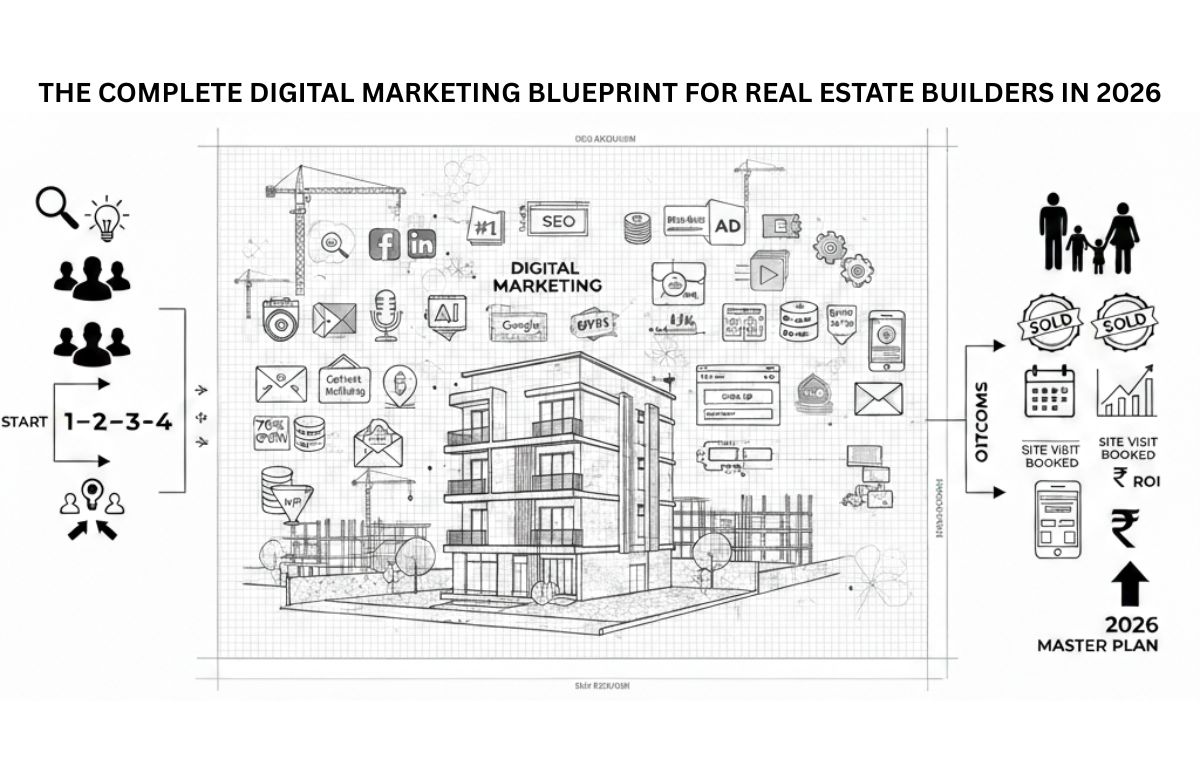
This blueprint lays out exactly what that system looks like in 2026 — and how builders who adopt it will outperform those who don’t.
Five macro shifts are redefining how buyers discover, evaluate, and purchase property — and builders who don’t adapt will find themselves invisible.
Platforms like Google and Meta now use machine learning to optimize ad delivery in real time. Builders who feed these systems rich audience data — interests, income signals, search behavior — will see dramatically lower cost-per-lead (CPL). Those who don’t will overpay for poor-quality traffic.
Buyers search with intent: “3 BHK flats in Kharadi under 90 lakhs.” If your project doesn’t appear for these hyperlocal, high-intent queries, you simply don’t exist in that buyer’s consideration set. SEO for real estate builders is no longer about ranking for broad terms — it’s about owning specific micro-markets.
Generic demographic targeting is being replaced by behavioral and intent-based signals. The builders generating consistent qualified leads in 2026 are those running performance marketing for builders with precise audience layering — not spray-and-pray campaigns.
Short-form video now dominates discovery. Reels, YouTube Shorts, and WhatsApp Status are how buyers form their first impressions of a project. A drone shoot or construction progress reel outperforms a static creative by 4-6x in engagement and reach.
Today’s buyer completes 70% of their purchase decision before contacting a builder. This means your website, content, visuals, and Google presence must do the heavy lifting — long before your sales team gets involved.
🎯 Pillar 1: Strategic Project Positioning
Before any ad is run or any content is created, a builder must have absolute clarity on three questions: Who is this project for? What is the specific value proposition? And why should a buyer choose this project over the competition two kilometers away?
This requires proper target audience segmentation — end-users versus investors, first-time buyers versus upgrade buyers, nuclear families versus large joint families. Each segment has different motivators, different price sensitivities, and responds to different messaging.
Pricing psychology also plays a critical role. How a price is anchored, presented, and communicated in digital touchpoints significantly impacts conversion rates. A real estate marketing strategy built without this foundation will generate volume — not quality.
🌐 Pillar 2: Website Designed for Conversion
Most real estate websites are brochures — not sales systems. A conversion-optimized real estate website design does several things simultaneously:
A well-designed landing page connected to Google Ads can reduce CPL by 30-50% compared to sending traffic to a generic homepage. This is one of the highest-leverage investments a builder can make.
🔍 Pillar 3: SEO for Long-Term Lead Generation
SEO for real estate builders is a long-term asset. Unlike paid ads that stop the moment you pause spend, SEO compounds over time — building a pipeline of organic leads that costs progressively less per acquisition.
A high-performance real estate SEO strategy in 2026 includes:
Builders who invest in SEO consistently report that organic leads convert at 2-3x the rate of paid leads — because those buyers have already done their research and are actively seeking what the project offers.
📊 Pillar 4: Google Ads & Performance Marketing
Google Ads for real estate remains the highest-intent paid channel available. Buyers actively searching for projects are further along in their decision journey than any other traffic source. But running Google Ads without a funnel strategy is where most builders waste their budget.
A funnel-based approach to performance marketing for builders runs three distinct campaign types:
Each stage of the funnel uses different creative, different bidding strategies, and different audience signals. Without this structure, builders end up spending 80% of their budget at the bottom of the funnel — competing for the same ready buyers everyone else is targeting — while ignoring the far more efficient upper-funnel opportunity.
📱 Pillar 5: Social Media Authority Building
Real estate social media marketing in 2026 is not about posting listings. It is about building brand authority, trust, and aspiration. The projects that generate the most walk-ins from social media are those that have built a consistent content presence over 6-12 months — not those that only advertise.
High-performing content formats for real estate builders include:
Consistency matters more than frequency. Three high-quality posts per week sustained over six months outperforms ten rushed posts per week for two months.
🏗️ Pillar 6: 360° Virtual Tours & High-Quality Visuals
Premium creatives are no longer a differentiator — they are a baseline expectation. Buyers evaluating a project online will scroll past low-resolution renders and poorly lit site photos. High-quality imagery and video directly impact time spent on the website and the likelihood of a lead form submission.
360° virtual tours take this further by allowing buyers to experience the unit before it is built. Projects that integrate virtual tours report 40-60% higher engagement on landing pages. For NRI buyers or those in other cities, virtual tours can substitute for a physical site visit entirely — dramatically expanding the addressable buyer pool.
Premium visuals are not a cost. They are a conversion multiplier.
📈 Pillar 7: Data Tracking & Optimization
The difference between a builder spending ₹5 lakhs per month on marketing and seeing results — versus spending the same amount and not — often comes down to one thing: tracking. Without proper attribution and analytics, there is no way to know which channels are working, which campaigns are generating qualified leads, and where the budget should be reallocated.
A complete real estate tracking system monitors:
This data drives optimization decisions on a weekly basis. Over three to six months, a well-tracked campaign will consistently improve in efficiency — reducing CPL while increasing lead quality.
Understanding what not to do is as important as knowing what to do. These are the most expensive mistakes builders consistently make with their digital marketing:
Eastera is a digital marketing agency that works exclusively with real estate builders. This focus means every strategy, every tool, every campaign framework has been developed and refined specifically for the builder context — not adapted from a generic marketing playbook.
The core difference in how Eastera works is the shift from running campaigns to building systems. A campaign generates leads for a launch window. A system generates consistent, qualified site visits month after month — regardless of market conditions.
The builders who will dominate their micro-markets over the next three years are not necessarily those with the largest budgets — they are those who build the most coherent, data-driven digital marketing systems. SEO compounds. Brand equity compounds. Retargeting audiences grow. Organic content builds trust over time.
Every month without a structured digital strategy is a month of ground ceded to competitors who are building these assets right now. A real estate marketing strategy for 2026 must account for AI-driven ad platforms, hyperlocal search behavior, video-first content consumption, and the reality that buyers complete most of their research before ever speaking to a sales team.
The question is not whether to invest in digital marketing. The question is whether to build a system that delivers compounding returns — or to keep spending on campaigns that stop working the moment the budget does.
Ready to Market Your Next Project the Right Way?
Partner with Eastera and build a digital marketing system that generates consistent, qualified site visits — month after month, project after project.
Whether you’re preparing for a new launch, sitting on unsold inventory, or planning your next project, Eastera’s team of real estate marketing specialists will design a system built around your specific project, buyer profile, and growth objectives.
Here’s what you get in a free strategy consultation:
👉 Book Your Free Strategy Call
FAQ 1: Why do real estate builders need digital marketing in 2026?
Today’s buyers complete 70% of their research online before ever visiting a site office. If your project doesn’t appear on Google, Instagram, or YouTube during that research phase, you simply don’t exist in their shortlist. Digital marketing ensures your project is visible at every stage of the buyer’s journey — from initial search to final decision.
FAQ 2: How does SEO help real estate builders generate leads?
SEO positions your project pages and website to appear when buyers search hyperlocal, high-intent queries like ‘3 BHK flats in Wakad under 80 lakhs.’ These buyers are actively looking, which means they convert at 2–3x the rate of paid traffic. Unlike ads, SEO builds a compounding asset — once you rank, the leads keep coming without incremental spend.
FAQ 3: Why are my Google Ads generating leads but the leads are poor quality?
This is one of the most common complaints from builders. Poor lead quality from Google Ads usually comes down to three causes: broad keyword targeting (attracting people in early research, not ready to visit), weak landing pages (not filtering or qualifying intent), and no negative keyword list (attracting irrelevant searches). A properly structured campaign with tight targeting and a conversion-optimized landing page significantly improves lead quality.
FAQ 4: What type of content works best for real estate on social media?
Construction progress Reels consistently generate the highest organic reach — buyers trust what they can see being built. Drone footage, customer testimonials, and lifestyle content (showing the life buyers will live, not just the flat) also perform strongly. Static posts of floor plans and price lists perform the worst. Video-first content is non-negotiable in 2026.
FAQ 5: What makes Eastera different from a general digital marketing agency?
Eastera works exclusively with real estate builders. Every strategy, tool, and campaign framework has been built and refined specifically for the builder context. This means faster execution, fewer learning-curve mistakes, and benchmarks drawn from real real estate data — not adapted from e-commerce or service industry templates.
Do you have questions about our services or pricing? We’re here to help. Contact our team, and we will reply to you as soon as possible.
Give Us a Call
Drop Us a Line
Office Location
Eastera is a creative-performance agency helping real estate brands grow with precision. We believe marketing should do more than look impressive — it should deliver real business results.
Eastera is a creative-performance agency helping real estate brands grow with precision. We believe marketing should do more than look impressive — it should deliver real business results.
Eastera – The Real Estate Digital Marketing Agency
Copyright © 2025-26. All rights reserved.