
Why AI-Powered Personalization Is the Future of Real Estate Marketing
For years, real estate builders and developers followed a simple script: blast a massive audience with generic ads, collect as many phone numbers as possible, and hope the sales team could filter through the noise. But in 2026, the “spray and pray” method isn’t just outdated—it’s expensive.
Today’s homebuyers are digitally savvy. They don’t want to be treated like a data point in a spreadsheet; they expect experiences tailored to their specific needs. If a young professional is looking for a 1BHK studio near a tech hub, showing them an ad for a luxury 4BHK villa in the suburbs is a waste of your marketing budget.
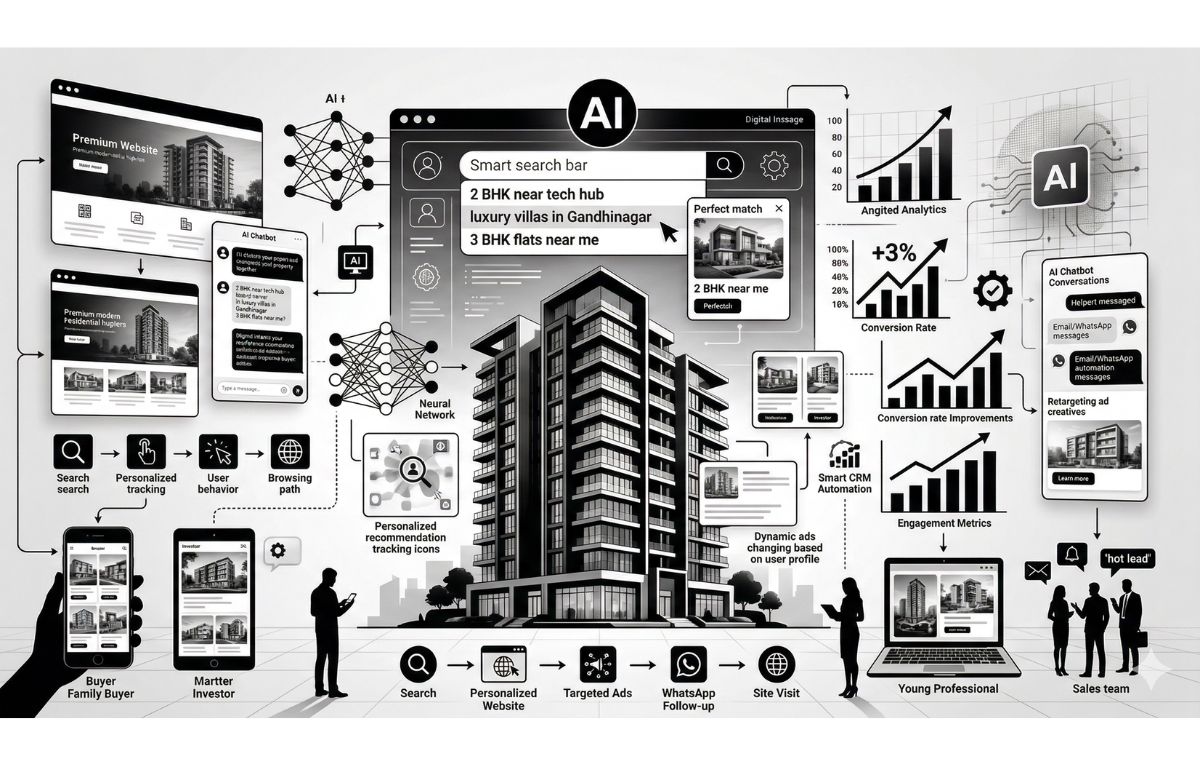
This is where AI-powered personalization in real estate changes everything. By leveraging data to deliver the right message at the right time, AI helps developers move away from generic noise and toward meaningful conversations. In this blog, we’ll explore how AI is revolutionizing lead quality and why it’s the ultimate tool for modern real estate growth.
At its core, AI-powered personalization is about using technology to understand a buyer’s unique journey and responding to it automatically. It isn’t about robots taking over; it’s about making your marketing feel more “human” at scale.
Instead of sending the same newsletter to 10,000 people, AI analyzes how an individual interacts with your website or ads. For example:
The old way of doing things is hitting a brick wall. Builders are spending more on ads but seeing fewer conversions. Why?
AI isn’t just a buzzword; it’s a practical engine that drives results through several key use cases:
Behavior-Based Targeting
AI monitors customer behavior tracking real estate data in real-time. It notices if a user is repeatedly checking the “Investment Potential” section of your website. The system then tags them as an “Investor” and automatically adjusts the marketing materials they see to focus on ROI and rental yields.
Predictive Analytics for Buyers
AI can predict which leads are most likely to close. By analyzing thousands of data points—from how long they spent on a video to their previous interaction history—the system flags “hot leads” for your sales team to call immediately, leaving the “cold leads” to be nurtured by automation.
Automated Follow-Ups
Using real estate marketing automation, you can create “if-then” scenarios. If a lead downloads a brochure but doesn’t book a site visit, the AI can trigger a personalized follow-up sequence that addresses common objections or offers a limited-time incentive.
Dynamic Website Content
Imagine two different people visiting your website. One sees a hero image of a family playground because they previously searched for “family-friendly apartments.” The other sees a sleek rooftop lounge because they are a young bachelor. This is the power of dynamic, AI-driven web interfaces.
The transition to AI-driven strategies offers five massive advantages for developers and agencies:
How does this look on the ground? Let’s look at three scenarios:
Scenario 1: The Smart Website A developer has three ongoing projects: an affordable housing scheme, a luxury villa township, and a commercial complex. When a user arrives via a Google search for “luxury homes,” the entire website layout shifts to highlight the villas, complete with a chatbot that introduces itself as a luxury concierge.
Scenario 2: The WhatsApp Drip A prospect visits a site office but doesn’t book. An AI-powered marketing automation for builders tool sends a “Thank You” message on WhatsApp. Over the next three days, it sends a high-quality drone view of the construction progress and a testimonial from a buyer in a similar demographic.
Scenario 3: Intelligent Retargeting A user views the “3BHK penthouses” page but leaves. Instead of seeing a generic project ad on Facebook, they see a carousel ad specifically showcasing the interior design of the penthouses they were just looking at.
You don’t need to be a software engineer to use these. Most AI tools for real estate marketing are designed to integrate seamlessly with your existing workflow:
Adopting these technologies can feel overwhelming for busy developers. That’s where Eastera comes in. We specialize in bridging the gap between traditional real estate expertise and the latest real estate digital marketing trends 2026.
Eastera provides an end-to-end ecosystem designed to scale your sales:
In the competitive landscape of 2026, AI-powered personalization in real estate is no longer a luxury—it is a necessity. Buyers have lost patience with irrelevant marketing, and developers who continue to use “one-size-fits-all” strategies will find their margins shrinking.
By embracing AI, you can understand your buyers better, shorten your sales cycles, and ensure that every marketing dollar spent is an investment in a high-quality lead. The future of real estate isn’t just about building better structures; it’s about building better connections.
Want better quality leads for your real estate project? Connect with Eastera today and start using AI-driven marketing strategies that actually convert.
Do you have questions about our services or pricing? We’re here to help. Contact our team, and we will reply to you as soon as possible.
Give Us a Call
Drop Us a Line
Office Location

Eastera is a creative-performance agency helping real estate brands grow with precision. We believe marketing should do more than look impressive — it should deliver real business results.
Eastera is a creative-performance agency helping real estate brands grow with precision. We believe marketing should do more than look impressive — it should deliver real business results.
Eastera – The Real Estate Digital Marketing Agency
Copyright © 2025-26. All rights reserved.